Energy Is the €300 Billion Hole in Europe’s External Strength
Europe’s goods surplus hides a major structural weakness: imported energy absorbs much of the bloc’s underlying trade strength and leaves it exposed to price shocks.
Renaissance Europe
Europe’s 2025 goods surplus masked a nearly €299bn energy trade deficit. Without imported fossil fuels, the EU’s goods balance would have been far stronger. Electrification and a real single energy market are now central to Europe’s external strength, industrial competitiveness, and strategic autonomy.
Europe’s economic resilience will increasingly depend on one structural variable: energy. In 2025, the EU recorded a goods trade surplus of around €128 billion. On the surface, that confirmed Europe’s continued strength as one of the world’s largest industrial and export powers. But the headline figure hid a deeper weakness: the EU’s energy trade deficit stood near €299 billion.
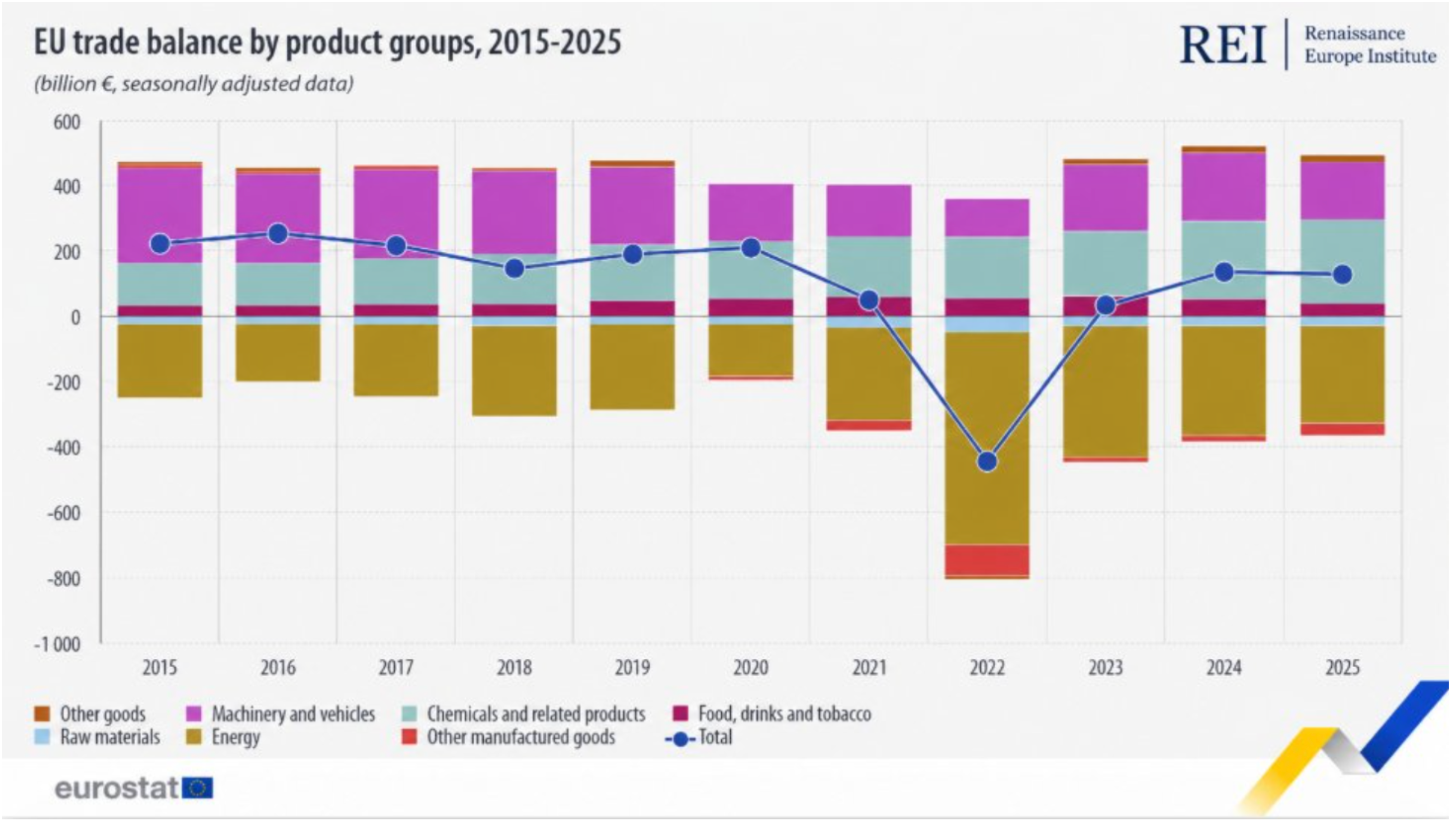
Figure 1
Europe’s external strength is weakened by a persistent energy deficit that absorbs much of the surplus generated by its industrial export base.
Source: Eurostat
Without Europe’s structural dependence on imported fossil fuels, the goods balance would have been much stronger, closer to roughly €427 billion. In other words, energy imports absorbed around 70% of Europe’s underlying goods surplus.
Energy Is Europe’s External Vulnerability
This is not a temporary accounting issue. It is one of Europe’s most important strategic vulnerabilities. Every major geopolitical shock exposes the same weakness. When oil, gas, or LNG prices rise, Europe’s external balance deteriorates. Industrial costs increase. Households lose purchasing power. Governments are forced to intervene. Companies face weaker margins, lower competitiveness, and higher uncertainty.
Europe’s problem is not a lack of productive capacity. It is that too much of its industrial and household energy base still depends on imported fossil fuels priced in volatile global markets.
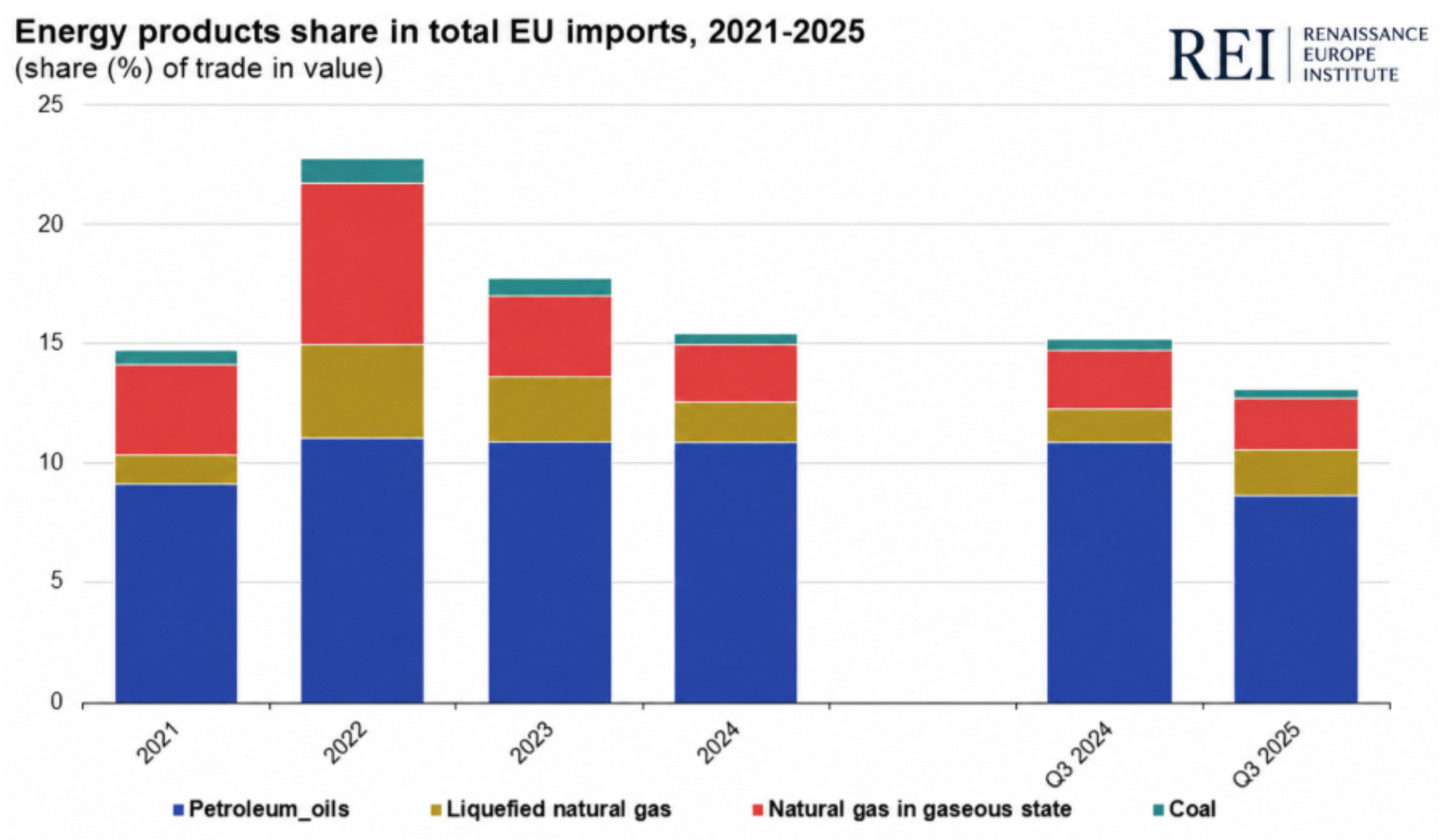
Figure 2
Europe’s industrial surplus remains large, but the energy deficit continues to drain much of the bloc’s external strength.
Source: Eurostat
How imported energy weakens Europe
| Channel | Effect | Strategic consequence |
|---|---|---|
| Trade balance | Fossil-fuel imports reduce the goods surplus | Weaker external position |
| Industry | Higher energy costs compress margins | Lower competitiveness |
| Households | Energy shocks reduce purchasing power | Weaker consumption |
| Governments | Price spikes force intervention | More fiscal pressure |
| Geopolitics | Import dependence creates exposure | Lower strategic autonomy |
Source: Article analysis
Electrification Is Macroeconomic Policy
That is why electrification is not only a climate policy. It is macroeconomic policy, industrial policy, and strategic autonomy policy. If Europe moves toward the Commission-aligned objective of roughly 60% electrification by 2050, the effect on the external balance could be enormous.
Replacing imported fossil fuels with domestically generated electricity from renewables, nuclear, hydro, storage, and integrated grids would reduce one of the largest structural drains on Europe’s current account. It would also make Europe less vulnerable to oil and gas shocks driven by events outside its control.
A Fragmented Energy System Keeps Europe Weaker
A fragmented energy system keeps Europe weaker. A continental energy market would allow the EU to use its full geographic advantages: sun in the south, wind in the north, hydro in Scandinavia, nuclear in France, and industrial demand across the core.
The logic is straightforward. Europe has the resources to build a more resilient internal energy system, but those resources are unevenly distributed. Without deeper interconnection, market integration, storage, and grid investment, the bloc cannot fully convert regional energy strengths into continental resilience.
Europe’s current weakness
- Imported fossil-fuel exposure
- Fragmented grids and markets
- Uneven energy resources
- Industrial cost divergence
- Vulnerability to external shocks
Strategic energy model
- Integrated continental grids
- More domestic low-carbon power
- Better cross-border transmission
- Storage and flexibility investment
- Lower external energy dependence
Conclusion
Building a real single European energy market and accelerating electrification must become an absolute strategic priority for Europe. The issue is no longer only climate, nor only energy security. It is the foundation of Europe’s external strength.
Europe’s industrial base can still generate large surpluses, but those surpluses are weakened when imported energy absorbs so much of the gain. Reducing that drain would improve the trade balance, lower exposure to geopolitical shocks, support industrial competitiveness, and strengthen strategic autonomy.