Turkey Faces Severe Balance of Payments Pressure as Oil Surges Toward $100
Rising oil prices are exposing Turkey’s dependence on imported energy, intensifying pressure on the lira, reserves, inflation, and the current account.
OpenMacro
Turkey’s heavy dependence on imported energy is turning the 2026 oil shock into a major balance-of-payments risk. Higher oil prices are widening the current account deficit, weakening the lira, straining reserves, and complicating the fight against inflation.
urkey is confronting significant economic headwinds as global energy prices continue to climb sharply, fueled by escalating tensions and conflict in the Middle East.
Brent crude has surged above $100 per barrel in recent days, exposing the country’s deep structural dependence on imported oil and natural gas. As one of the world’s most energy-import-dependent major economies, Turkey imports over 90% of its crude oil and nearly 96% of its natural gas.
Annual energy imports have historically ranged between $60 billion and $90 billion, often accounting for 20% to 25% of total imports and representing 3.5% to 4.5% of GDP. The sudden spike in prices is rapidly widening the current account deficit, which had shown some improvement in 2025 but is now projected by analysts to deteriorate further, potentially reaching $32 billion to $50 billion for 2026 depending on how long high prices persist.
This external shock is placing enormous strain on the Turkish lira and the country’s foreign exchange reserves. The lira has been under sustained selling pressure, repeatedly hitting fresh all-time lows against the US dollar, trading near or above 44 TRY/USD in recent sessions.
To prevent a disorderly depreciation and maintain a degree of exchange-rate stability, the Central Bank of the Republic of Turkey has been forced to intervene aggressively by selling foreign currency reserves. Net FX reserves, excluding swaps, have declined sharply since earlier this year, with some estimates showing tens of billions of dollars used in interventions since the intensification of regional conflicts.
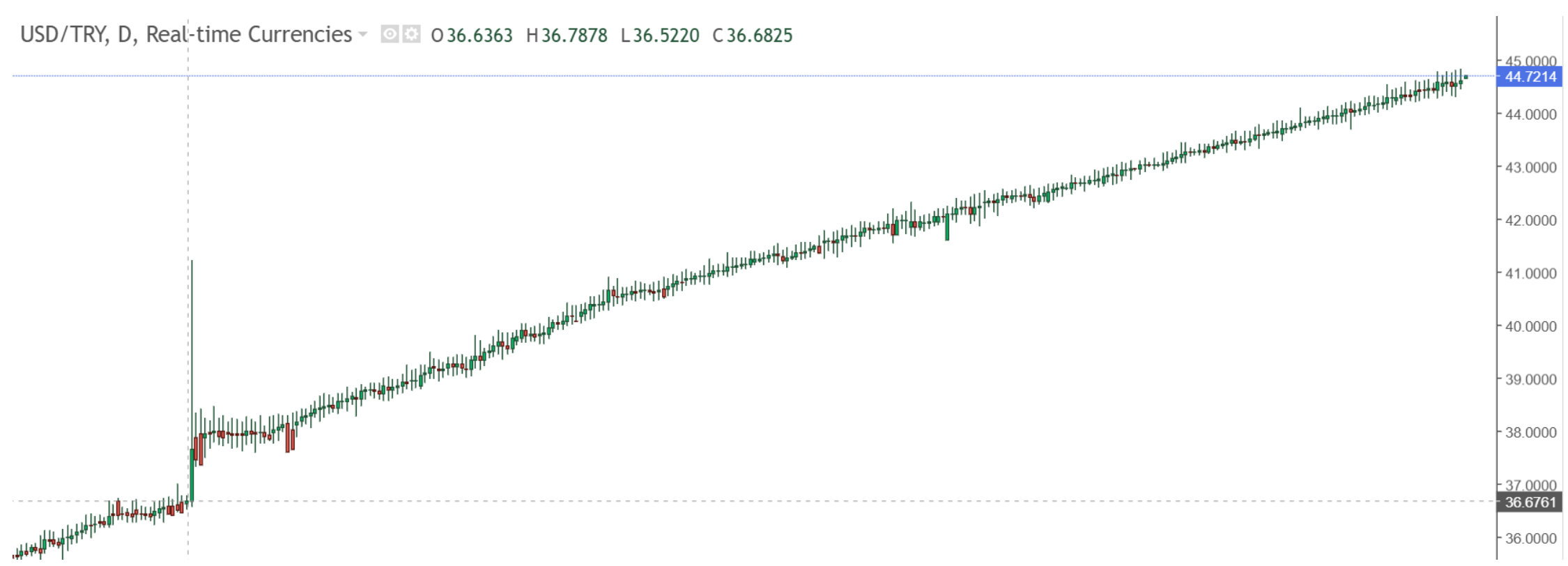
Figure 1
A USD/TRY candlestick chart showing the Turkish lira’s steady depreciation and the dollar’s rise toward fresh highs, illustrating mounting external and currency pressure.
Source: OpenMacro
Every $10 increase in oil prices is estimated to add roughly $4.5 billion to $5 billion annually to Turkey’s energy import bill, according to CBRT and independent analyses. With Brent now well above the government’s earlier planning assumptions, around $65 to $85 per barrel, this mechanical effect alone is significantly worsening the external balance.
The situation is compounded by stubbornly high inflation, with forecasts for 2026 now revised upward to around 29% to 35% in stress scenarios by agencies like S&P Global, and by questions over the sustainability of the central bank’s reserve-defense strategy. Economists warn of a dangerous feedback loop: higher energy prices widen the current account deficit → pressure on the lira intensifies → imported inflation accelerates → further strain on reserves and monetary policy. As Goldman Sachs and other institutions have noted in recent commentary, Turkish policymakers are walking a tightrope — trying to balance currency stability, disinflation efforts, and the need to preserve buffers for future shocks. On the fiscal side, the government has activated mechanisms such as sliding-scale fuel tax adjustments to absorb part of the price shock domestically, but officials have acknowledged that these measures are not sustainable if high oil prices persist. Energy subsidies through BOTAŞ are also rising sharply, adding pressure to the budget.
President Erdogan’s administration continues to emphasize growth and relatively supportive borrowing conditions, but external vulnerabilities are becoming increasingly difficult to contain. Markets are now closely watching upcoming current account data, monthly reserve figures, and any signals from the CBRT on interest-rate policy.
In summary, while Turkey’s economy has shown resilience in recent years through orthodox adjustments, the combination of a major energy price shock, fragile net reserves, and a weak currency creates a challenging environment. How Ankara navigates this perfect storm will be critical for confidence, capital flows, and the country’s broader macroeconomic stability in 2026 and beyond.