What the European Union Needs to Become a Global Superpower in the 21st Century
The next decade will decide whether Europe becomes a global power or a declining bystander by turning its economic scale into strategic strength in energy, technology, defense, finance, and governance.
OpenMacro
The EU has the market size, population, and regulatory weight to become a true global superpower, but only if it mobilizes capital, secures energy sovereignty, rebuilds industrial strength, leads in technology, and acts with greater political cohesion in the decade ahead.
In the multipolar world of 2026, the European Union stands at a decisive moment. The United States and China still dominate the commanding heights of technology, military power, and industrial scale, yet Europe retains formidable assets of its own: a combined GDP of roughly $22.5 trillion, a population of more than 450 million people, the world’s largest single market, and unmatched regulatory reach. On paper, those are the foundations of a superpower. In practice, they remain underleveraged.
Mario Draghi’s 2024 warning that Europe risks a “slow agony” without radical transformation has only become more relevant. The productivity gap with the United States has widened to roughly a third over the past quarter-century, while fragmented capital markets, regulatory complexity, external energy dependence, and weak strategic coordination continue to limit Europe’s ability to convert economic weight into geopolitical influence.
The next decade will therefore be decisive. If the EU can mobilize investment, complete its internal market, secure energy sovereignty, and build credible strength in technology, defense, and governance, it can emerge as one of the defining powers of the 21st century. If it cannot, it risks remaining wealthy but strategically constrained: influential in rules, but weaker in execution.
1. Completing the Savings and Investments Union
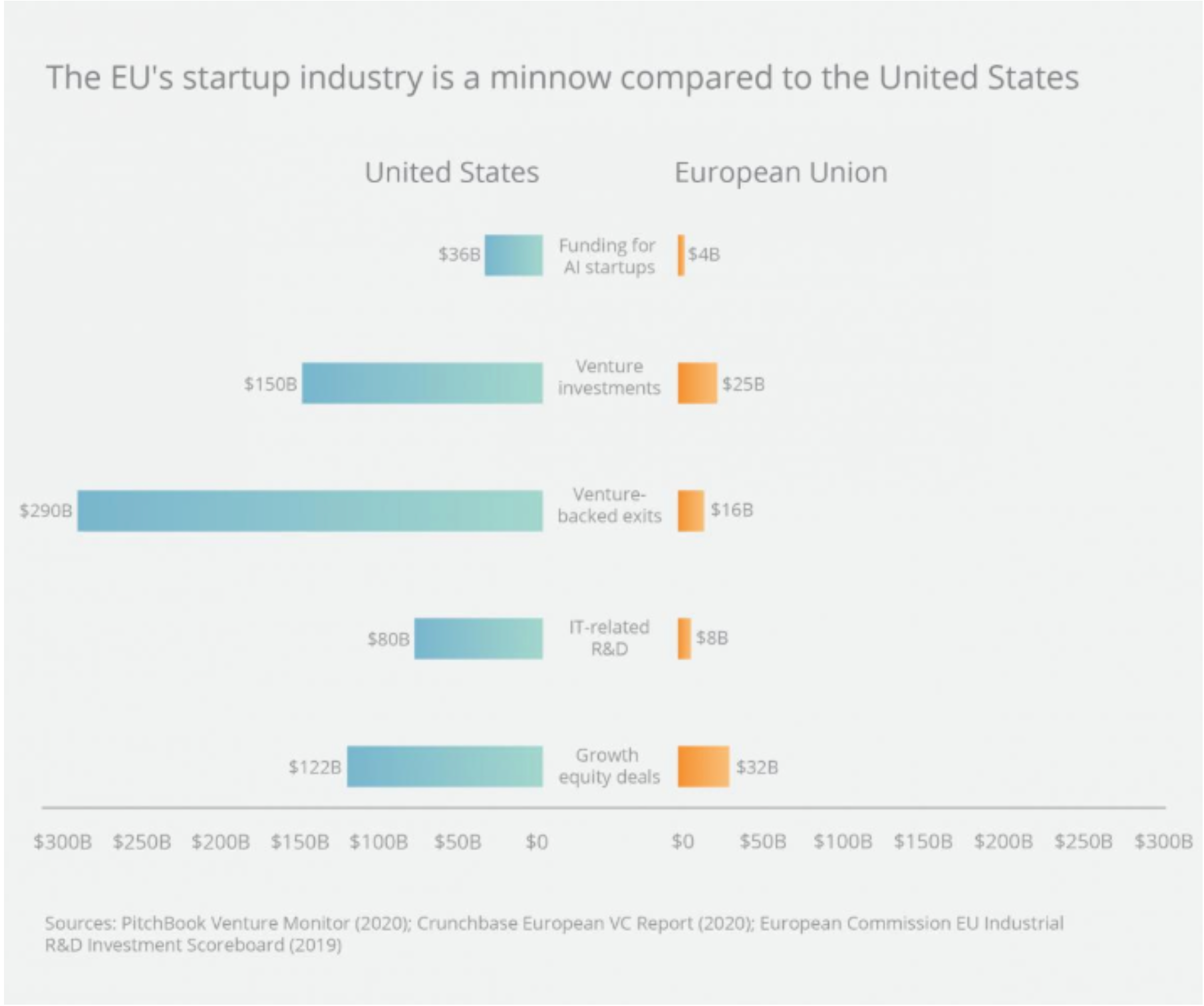
Figure 1
The scale gap between the US and EU startup ecosystems shows why Europe must deepen capital markets, expand late-stage funding, and strengthen innovation financing to compete globally.
Source: PitchBook Venture Monitor (2020); Crunchbase European VC Report (2020); European Commission EU Industrial R&D Investment Scoreboard (2019)
Europe’s financial architecture remains too fragmented for a bloc that wants to compete with the United States and China. American capital markets are deep, liquid, and unified, allowing firms to raise large amounts of risk capital and scale rapidly. Europe, by contrast, still depends too heavily on bank lending, which is less effective for high-growth sectors such as artificial intelligence, biotech, semiconductors, and advanced manufacturing.
The original Capital Markets Union has evolved into the Savings and Investments Union, but progress remains incremental. Partial harmonization of insolvency regimes and steps toward greater market transparency are useful, yet they fall well short of what Europe needs. A genuinely integrated system would allow capital to move across borders with fewer legal and regulatory frictions, create more attractive listing conditions for growth companies, and keep European firms from migrating to New York in search of funding depth.
The strategic importance of this is hard to overstate. A superpower needs not only great companies, but also a financial system capable of scaling them. Without that, Europe will continue to educate talent, incubate innovation, and then watch much of the upside accrue elsewhere.
Why SIU Matters
| Issue | Current EU Constraint | Strategic Effect |
|---|---|---|
| Fragmented capital markets | National barriers limit cross-border funding | Startups scale more slowly | — | |
| Bank-heavy financing model | Less suited to high-growth innovation | Higher financing costs for new sectors |
| Weak late-stage funding depth | Firms seek overseas listings or buyers | Europe loses control of scale-ups |
| Incomplete supervisory integration | Compliance remains uneven and complex | Investors face more friction and uncertainty |
Source: Framing based on Draghi report themes and article analysis
2. Forging a Truly Single Regulatory Market
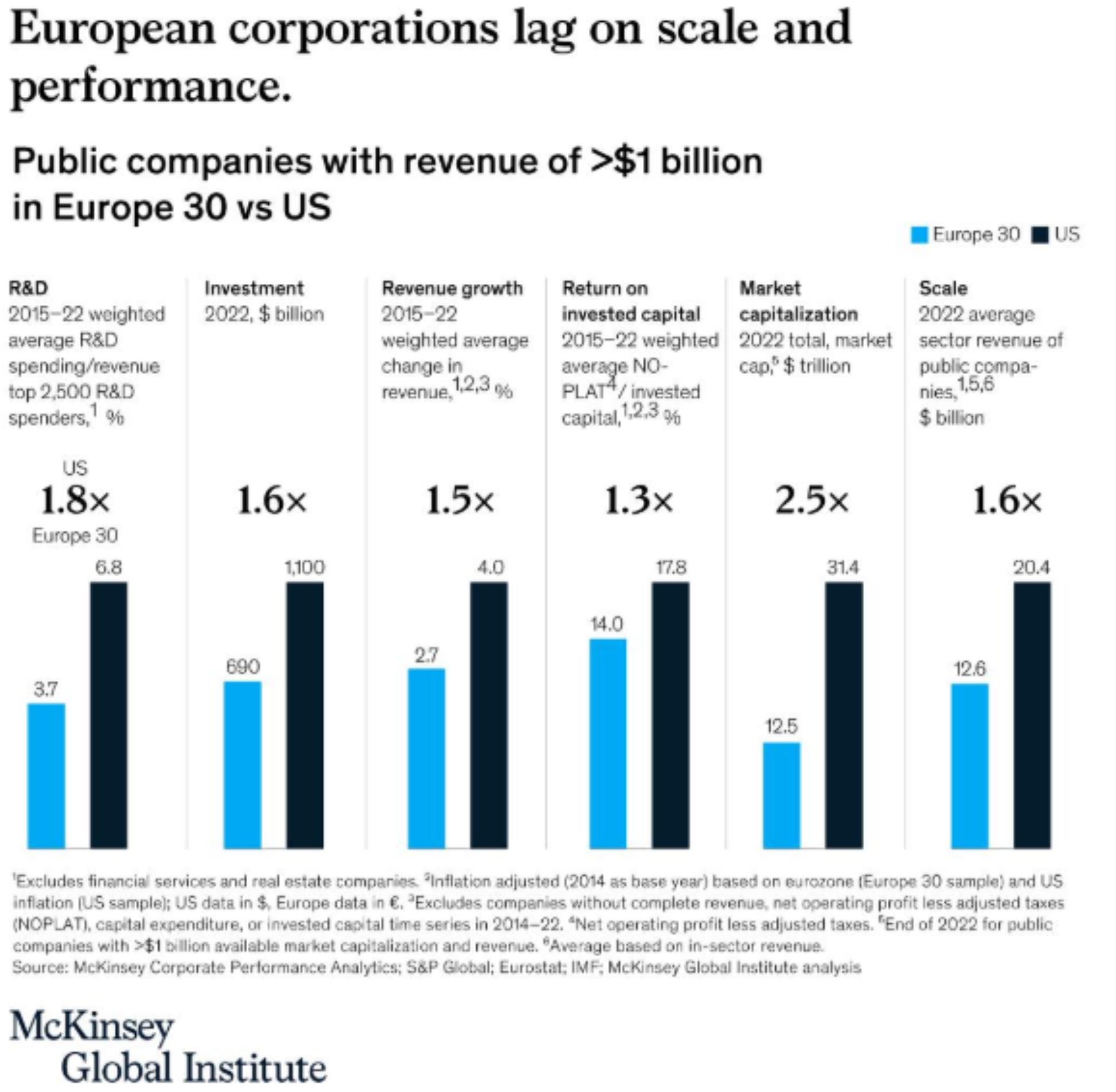
Figure 2
The gap between major European and US corporations underscores why Europe must improve scale, investment depth, and firm performance to compete as a global power.
Source: McKinsey Global Institute; McKinsey Corporate Performance Analytics; S&P Global; Eurostat; IMF
The Single Market remains Europe’s greatest achievement, but it is still not fully single in the way a superpower requires. Twenty-seven national regulatory systems continue to generate duplicative compliance burdens, inconsistent enforcement, and slower expansion for firms trying to operate across the bloc. That fragmentation carries a real economic cost in lost productivity and reduced innovation.
Enrico Letta’s idea of a “fifth freedom,” centered on the movement of knowledge, research, and innovation, points toward the right direction. So does the notion of an optional “28th regime” that would allow companies to operate under a more unified corporate, labor, and fiscal framework across the EU. If implemented seriously, such reforms could make Europe function less like a patchwork of national markets and more like a continental platform for growth.
This is not just a bureaucratic issue. It is central to competitiveness. If permits for gigafactories, digital infrastructure, energy projects, and industrial expansions remain slow and nationally uneven, Europe will continue to lose time in sectors where scale and speed matter most.
What fragmentation does
- Raises compliance costs
- Slows cross-border expansion
- Discourages startup scaling
- Creates enforcement inconsistency
- Reduces the appeal of Europe as one operating market
What a true single market would do
- Accelerate project permitting
- Lower regulatory duplication
- Strengthen the “EU Inc.” concept
- Make Europe more attractive for capital and talent
- Turn market size into actual strategic leverage
3. Achieving Energy Sovereignty
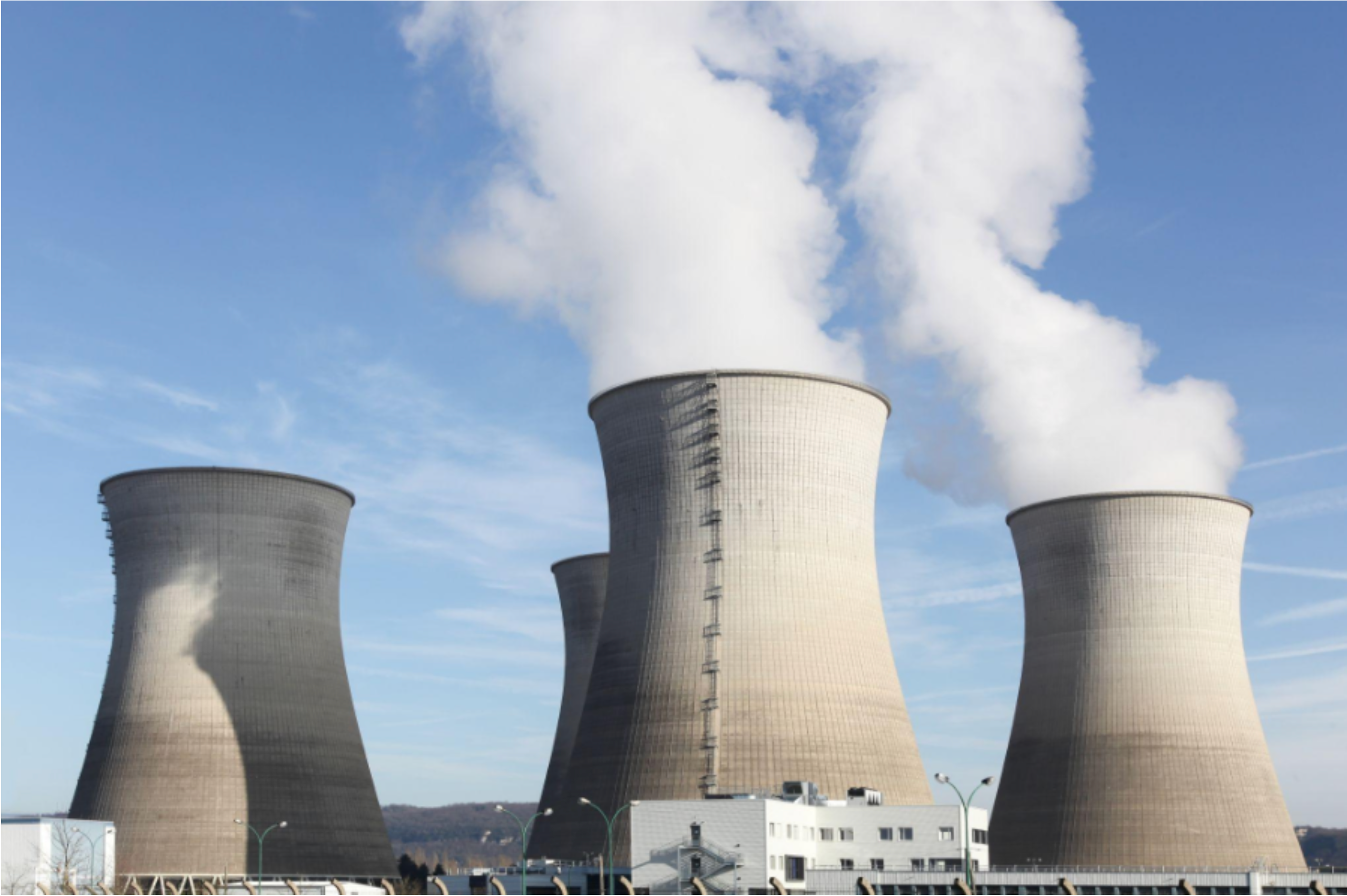
Figure 3
Energy sovereignty will require Europe to pair renewables with stable low-carbon generation, making nuclear power central to any credible autonomy strategy.
Source: OpenMacro
No power can be strategically autonomous while remaining structurally vulnerable in energy. The shock that followed Russia’s invasion of Ukraine made that reality impossible to ignore. Europe has made substantial progress since then, cutting Russian gas imports dramatically and accelerating policy frameworks such as REPowerEU, the Net-Zero Industry Act, and the Critical Raw Materials Act. But progress is not the same as sovereignty.
A true superpower strategy requires resilient domestic generation, modernized grids, storage capacity, hydrogen infrastructure, and supply-chain security for critical inputs such as lithium and rare earths. It also requires accepting that energy policy is now industrial policy, security policy, and foreign policy at the same time.
The long-term objective should be clear: a Europe that generates the overwhelming majority of its electricity from a stable mix of renewables and nuclear, electrifies transport and industry at much greater scale, and reduces exposure to external coercion through diversified supply chains. Energy independence is not only about cheaper power. It is about strategic freedom.
4. Embracing Strategic Industrial Policy
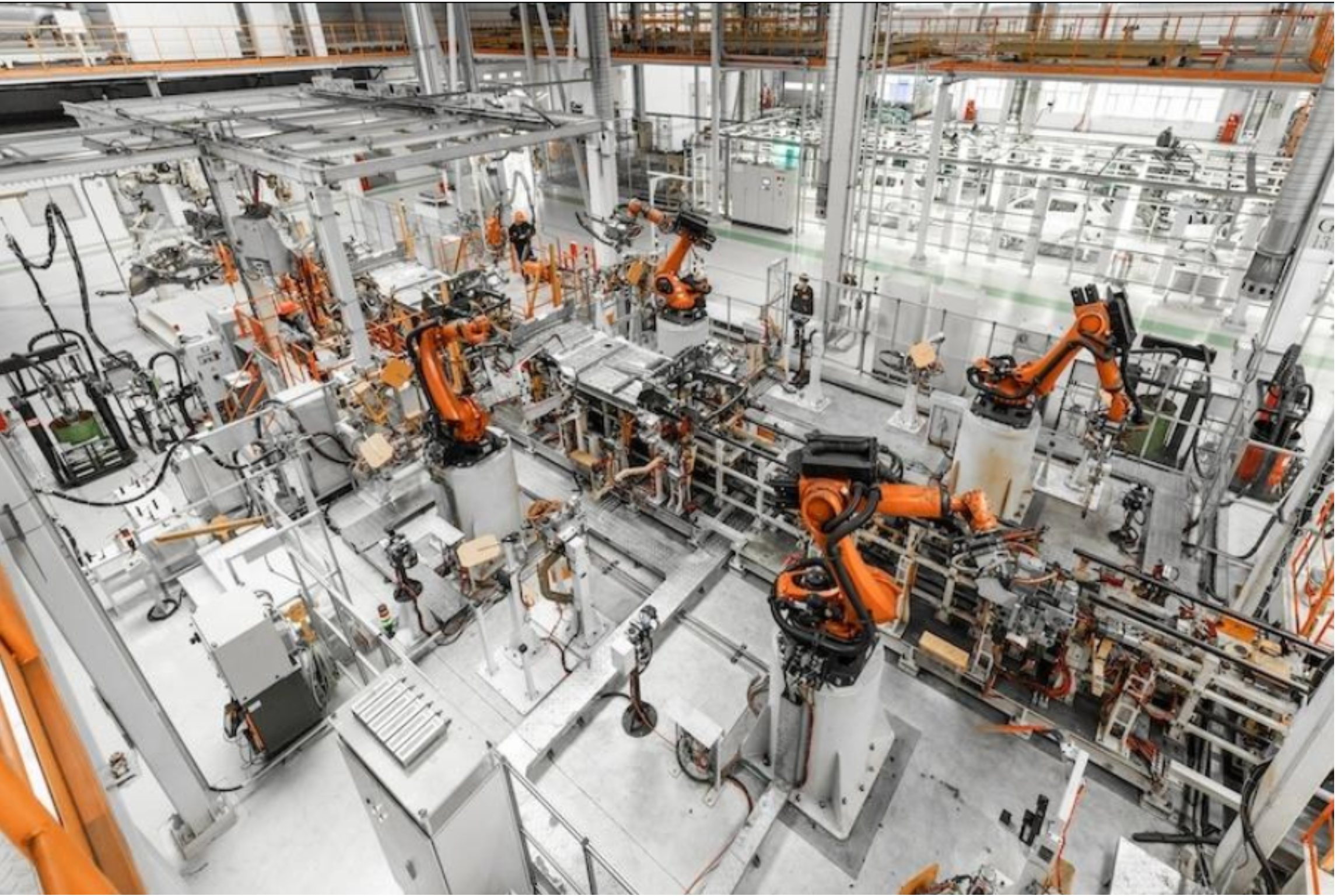
Figure 4
Rebuilding Europe’s industrial base will require not just subsidies, but faster permitting, cheaper energy, automation, and strategic investment in advanced manufacturing.
Source: OpenMacro
Europe can no longer rely on the assumption that market openness alone will preserve industrial strength. The United States is using subsidies and procurement aggressively through measures like the Inflation Reduction Act, while China continues to direct capital and policy toward strategic sectors at scale. Europe must respond with something more coherent than scattered national initiatives.
That does not require crude protectionism. It requires intelligent industrial policy: targeted public support, faster permitting, strategic procurement, cheaper energy for critical sectors, and a stronger ability to anchor value chains in batteries, chips, pharmaceuticals, defense, and advanced materials. The European Chips Act and net-zero industrial policies are steps in that direction, but they remain insufficient relative to the scale of the challenge.
A Europe that cannot produce enough of the technologies it depends on will not command genuine strategic autonomy. Industrial capacity is not an old-economy concern. It is the material basis of power in a world where supply chains are increasingly politicized.
5. Securing Technological Leadership
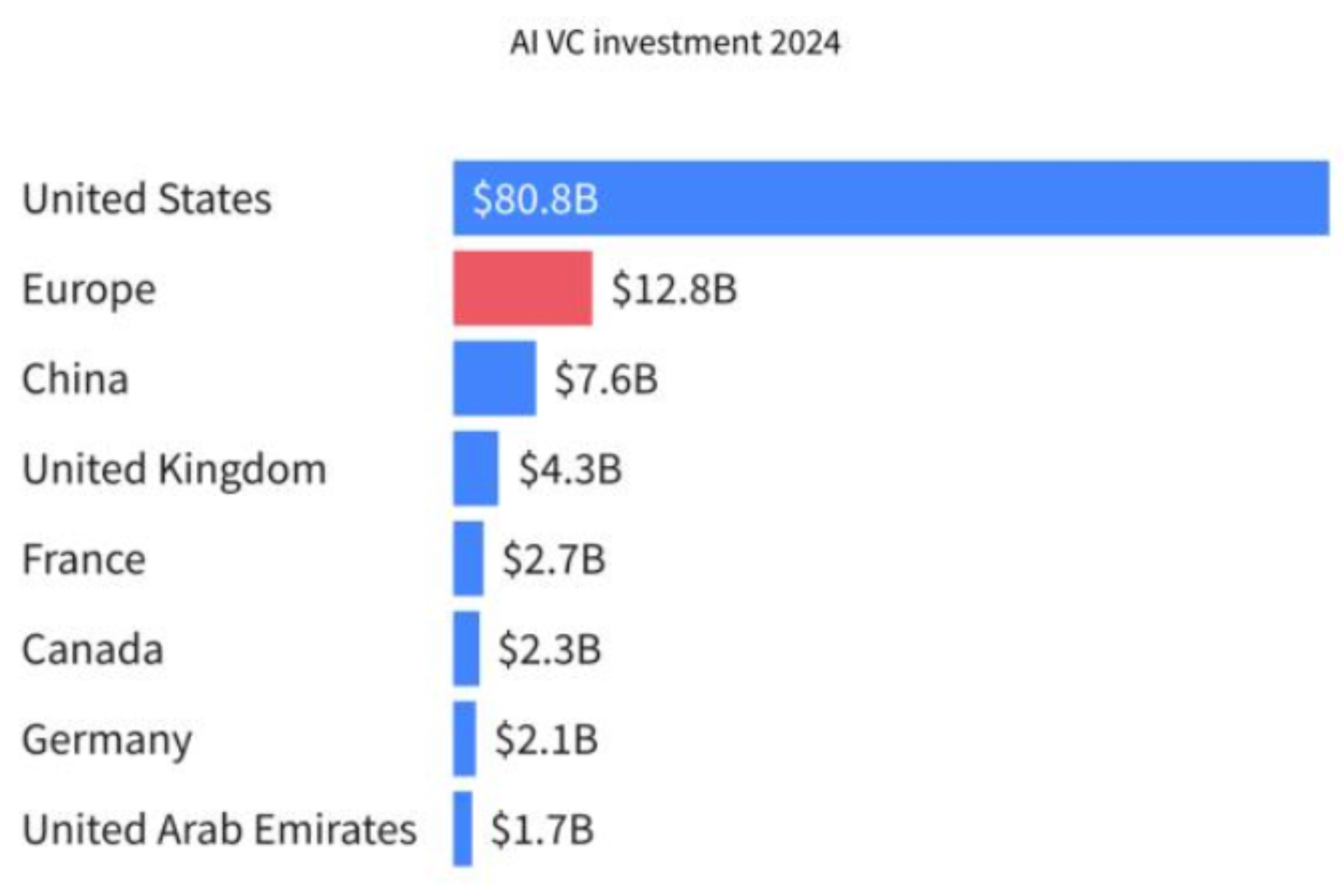
Figure 5
Europe’s AI funding gap remains stark, reinforcing the need for deeper capital markets, larger scale-up financing, and a more competitive innovation ecosystem.
Source: Dealroom.co
Europe has become highly influential in regulating technology, but regulation alone does not create technological power. The bloc has helped shape global digital norms through measures such as the AI Act and the Digital Markets Act, yet it still lags behind the United States and China in scaling frontier firms, commercializing research, and retaining elite technical talent.
That gap is especially dangerous because technological leadership increasingly determines military capability, productivity growth, industrial competitiveness, and geopolitical leverage. Europe does not lack universities, researchers, or engineering talent. It lacks the mechanisms to convert that base into globally dominant companies quickly enough.
To close the gap, the EU needs more risk capital, lighter burdens for startups, regulatory sandboxes for high-growth technologies, and greater tolerance for continental-scale champions. It must also make itself more attractive to global talent and less prone to losing its own innovators to larger and more permissive ecosystems abroad.
6. Building a Credible Defense Union
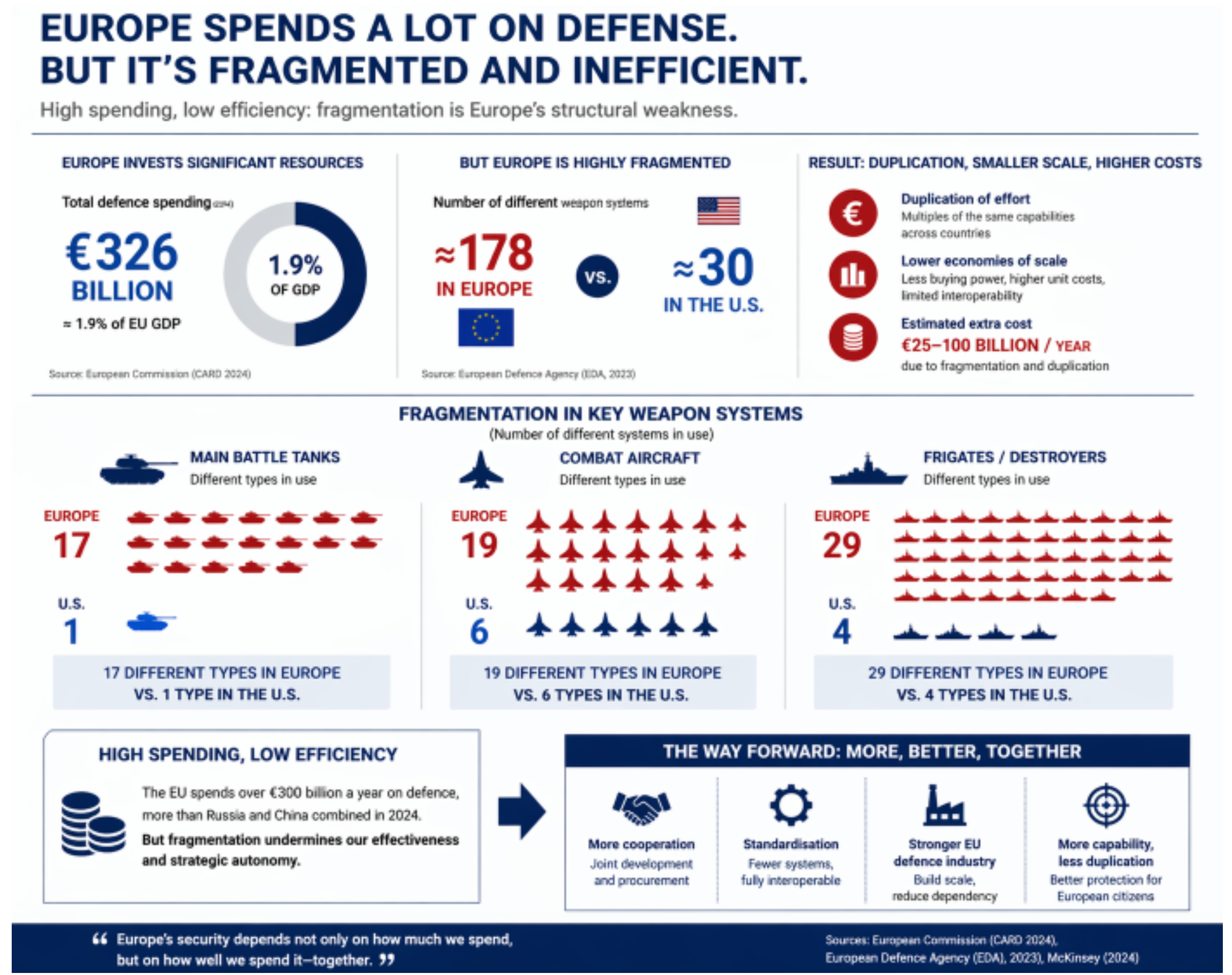
Figure 6
Europe’s defense challenge is not only how much it spends, but how inefficiently it spends across fragmented systems, duplicated capabilities, and weak economies of scale.
Source: European Commission (CARD 2024); European Defence Agency (EDA, 2023); McKinsey (2024)
No serious superpower can remain militarily fragmented and strategically dependent on another power for its ultimate security. Europe spends heavily on defense in aggregate, yet too much of that spending is duplicated, nationally siloed, and inefficient relative to the threats it faces.
Recent years have increased the urgency. Russia remains a direct security challenge, instability on Europe’s periphery continues to generate pressure, and Washington’s strategic focus is increasingly tilted toward Asia. That does not make NATO obsolete, but it does mean Europe must become a far more capable pillar within it.
A credible defense union would require more joint procurement, a more consolidated defense industrial base, higher levels of readiness, and stronger coordination on capabilities that matter in modern conflict. Strategic autonomy in defense does not mean severing alliances. It means being able to act when required and contribute meaningfully when alliances are strained.
7. Deepening Governance, Fiscal Capacity, and Foreign Policy Cohesion
Europe’s structural weakness is not only economic. It is institutional. A union that wants to act like a superpower cannot repeatedly allow unanimity rules and internal fragmentation to slow urgent decisions on sanctions, foreign policy, industrial funding, or strategic response.
That is why governance reform matters as much as industrial reform. More qualified majority voting in foreign policy, deeper fiscal coordination, stronger joint financing tools, and better alignment between strategic priorities and budget capacity would make Europe more agile and credible. The bloc’s market power already gives it leverage in trade and standards. The question is whether it can pair that leverage with faster decision-making and clearer external purpose.
Without that, Europe risks remaining a giant in economic regulation but a laggard in hard strategic action.
What would make Europe a real superpower?
Conclusion Europe has many of the ingredients of a 21st-century superpower: market size, talent, institutional depth, industrial legacy, and global regulatory influence. What it lacks is not potential, but consolidation. The central challenge is to turn scale into power across finance, regulation, energy, industry, technology, defense, and governance.
That is why the next decade matters so much. If the EU completes the Savings and Investments Union, reduces internal fragmentation, secures energy sovereignty, backs strategic industries, builds technological leadership, strengthens defense integration, and reforms its decision-making architecture, it can emerge as one of the defining powers of the century. If it fails, it risks becoming something far weaker: prosperous, stable, and respected, but strategically secondary.
Europe’s future therefore hinges less on whether it has the resources to lead than on whether it has the political will to act like a power that intends to lead.